
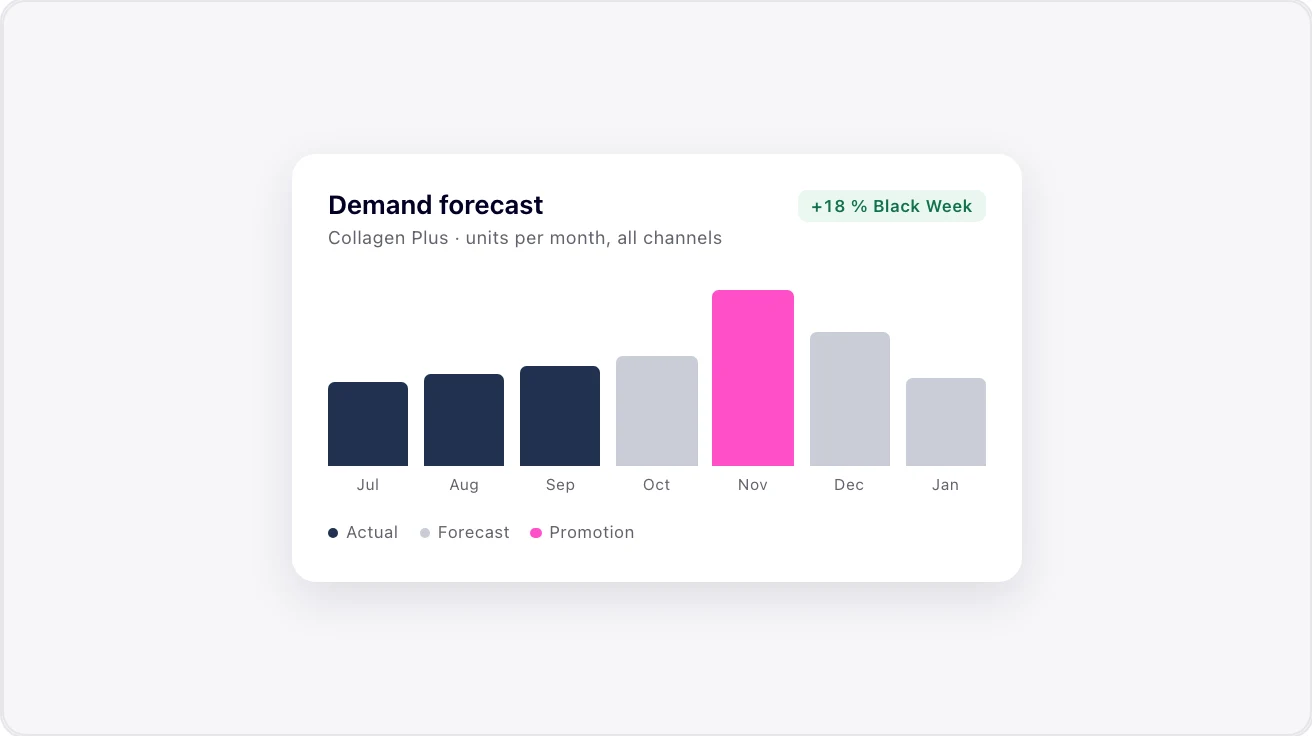
For teams that need a structured entry into forecast models, data quality, OOS correction, and implementation.
Why this matters
The guide is the conceptual entry point into demand forecasting for e-commerce. It explains which data truly matters: historical sales, availability, campaigns, product attributes, variants, seasonal patterns, and external peaks such as Black Friday.
Correcting stockout bias is especially important. If a bestseller is unavailable for three weeks, a naive forecast only sees low sales. A good forecast recognizes that demand did not disappear; it could not be served.
Implementation is not just about training a model. Teams need an operating routine: review the forecast, evaluate risk, derive order quantities, prioritize purchase orders, and later measure whether OOS and overstock actually decline.
Chapters and takeaways
01 Fundamentals and data foundation
The guide explains which historical sales, inventory, campaign, and product data are needed for forecasting.
02 Models and common mistakes
It covers model types, overfitting, missing out-of-stock correction, and false interpretation of zero sales.
03 E-commerce implementation
Forecasts become buying decisions, inventory reach, reorder priorities, and operating routines.
Operator checklist
- Check data sources and data quality
- Correct stockout bias
- Define forecast granularity at SKU/variant level
- Model campaigns and seasonality
- Translate forecast into replenishment process